Monday, September 07, 2015


On a walk near Conowingo I saw this bird posing for me.   I assume it to be a Great Blue Heron.  I would have liked a selfie with this bird.

Wednesday, August 26, 2015

Malcolm Hollett


An inaugural message as I return to my blog after stepping down from my work at St. Joseph's Prep


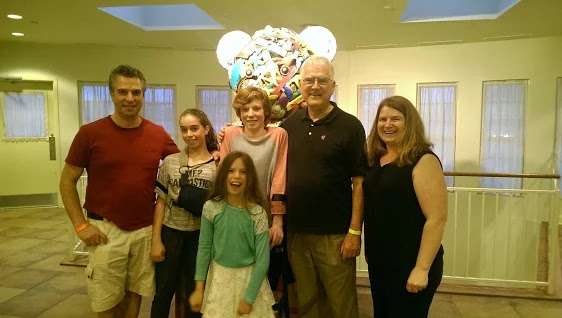
August, 2015    The young man in the center of the photo is Malcolm Hollett, student of St. Bonaventure's High School, a Jesuit school in St. John's, Newfoundland.  Malcolm came to the Shriners Hospital in Philadelphia in March to learn how to walk again after a serious skiing accident.  After five months of rehab he is walking on crutches and his hard work has restored feeling to most of his lower body.   He, his parents (Phil and Elizabeth) and his sisters (Camilla and Cecilia)  recently returned to Newfoundland where Malcolm will continue his rehab.  We look forward to seeing him in Philadelphia in February when he returns for a refresher course at Shriner's.   The staff there and the hospitality of the Ronald McDonald House made all this possible.

When I first met Malcolm and prayed with him, I asked him what we should pray for and he paraphrased a line from the New Testament: "I want to walk."    His desire and God's love for him through family and caregivers has made his desire come true.   This is a young man with great grit and a great future.


November 2018:  After more than three years of hard work and consultation with rehab specialists, Malcolm now walks with one cane and can go miles if needed.    He still wears a simple brace on one foot and the next goal is the training of those bones and muscles.

Tuesday, January 31, 2012

Refer to Saint Joseph's Prep Main Page for President's Blog

Those of you looking for more entries, please check the President's Message site on the web page for Saint Joseph's Prep in Philadelphia.

It's more appropriate for me to use that site for entries that reference the school. Some personal items are posted there as well.

Thank you

George W. Bur, S.J.

Saturday, May 07, 2011

Gesu Spirit Medal


Words of Gratitude on the occasion of the Gesu Spirit Medal,
May 2, 2011 at the Constitution Center


Thank you, Byron! My gratitude first to those at Gesu who invited me to share this honor not only with Chris Beck but also with Mark Solomon, Ralph Saul, Al and Aline Martinelli, Sue and Bill Shea, John DiIulio and Jay Sherrerd. Thank you, Chris. You made the work of the first ten years of the Gesu independent school a prelude, a kind of seed that fully blossomed in the amazing physical and programmatic additions of the last eight.


I thank the people of what was the Gesu parish whom I first met 26 years ago and who encouraged me and the Jesuits and the Sisters to keep Gesu School alive as a pillar of strength for neighborhood children regardless of what might happen to the parish. Many of those men and women, including Byron McCook are here tonight. They bore the heat of the day, and because of their vision and strength, for a long time into the future children from the Gesu neighborhood can walk happily to Gesu School.


I thank my siblings Eileen, Jeanne, Tony and Mary, and my in-laws Peggy and Frank, for their constant support not only for the children of Gesu but for me personally over a far longer period of time. And my nieces and nephews who took time away from their own children and their other obligations to enjoy tonight’s program.


I thank the Jesuits and the Sisters who went before us at Gesu. Without 125 years of the Gesu Church and the School before 1993 there would be no independent Gesu Catholic School.
I thank a Gesu graduate who joined Byron McCook and me when we first started a development program for the school in 1988: Jim Higgins from the Gesu class of 1945. Thank you, Jim, for your marathon run with us.


I thank my brother Jesuits, present housemates on 18th St., Father Neil especially with whom I served at Gesu for 14 years. He knew my weaknesses from day one and stepped up to fill in for me when necessary.


I thank Sister Ellen and Sister Pat and all of the IHM Sisters who have an uncanny understanding of children and their needs. They and the Gesu faculty and staff are amazing. How many years, Shirley Bright? How many years, Dolores John? They are the chief reason why young boys and girls from Gesu are able to take on confidently the challenges of high school.


In his absence, (I miss him but regretfully he had an unavoidable obligation this evening), I thank my schoolmate and good friend, Win Churchill, for his personal support and for his cheerfully persistent efforts over the past 21 years to place the success of the children of Gesu School before a steadily increasing group of friends. Without him and his many friends the Gesu School would be, if anything at all, a weak image of itself.


I thank Frank and Keith Pension and Bill and Elise Rouse. I thank all of you gathered this evening around a vision of a world where all children have an opportunity to be healthy and to grow and succeed so that their gifts, too, can make a better world.


Finally I thank the children of Gesu and their parents and caregivers who are striving to be the best that they can be and who teach us, friends, parents, teachers, board members, all to believe in our best selves. There is no better world than one in which we show our best selves to one another.


And if I have saved the thanks for God to last, it is because the living God is not only Other but also present in all of us in this room. We give thanks for that divine presence and we count on it as we continue to gather around this wonderful school and its children.


Friday, April 22, 2011


HOLY THURSDAY LITURGY AT MEDICAL MISSIONS APRIL 21, 2011


This evening we celebrate Jesus sharing his body and blood in the Passover meal of bread and wine with his closest friends. “This is my body; this is my blood.” This evening we celebrate Jesus washing the feet of the disciples as they celebrate the Passover. “Jesus, wash me and not only just my feet but my head and my hands as well.” We focus our attention in this supper room on these images of Christ’s love for us as a way of fostering the faith which has kept these images alive. I suggest them as consoling images. Without these images the atmosphere of betrayal, of indecision and of cover-up in that supper room threatens to give the lie to the entire Christian enterprise.

It is, I suggest, this same kind of atmosphere, that of betrayal, indecision and cover-up, which envelops our local church during this 2011 season of Lent and Easter. The sexual abuse of minors by clerics and the lack of honest disclosure of all the facts leave many of us Catholics feeling angry and dispirited. The local diocesan clergy are not alone as the cause this crisis. Nationwide religious orders like the Jesuits are deeply negligent. We failed to screen and form our members properly. We responded to reports of abuse by protecting the abusers and with little understanding of the abused.

To whom do we go? We hesitate to give church leaders our trust. In this angry and dispirited time I suggest that we remember that Jesus himself understands betrayal. The supper room’s images of nourishment and humble kindness also include other images. There is one of Jesus’ disciples whom he invited to follow him, one whom he entrusted with leadership and responsibility. This man, Judas, betrayed him. None of the other chosen disciples, though they clearly knew the danger in which Jesus found himself, paid any attention to the possibility of betrayal. One disciple, we think it John, even knows the identity of the betrayer. They let betrayal happen under their noses. And then the chosen leader of the group, Peter, engineered his own personal cover-up and denied that he even knew Jesus.

Through all this Jesus himself continues to trust in the God whom he calls his Father.
In seeking how to handle betrayal by those whom we trusted, we remember other Christians in other circumstances who suffered under the sinfulness of the Church. Our African-American brothers and sisters suffered the sin of slavery, a slavery not just condoned by the Church. Organizations in the Church held slaves as well.

We remember the Jews persecuted by Christians especially in European pogroms.

We remember the poor in some of the countries of Latin America where Bishops stayed silent while their political leaders murdered innocent people, a silence to protect the position of the Church in civil society.

We remember especially the women and children whose voices went unheard in all these circumstances.

The slaves, the Jews, the murdered innocents! The legacies from these sufferings continue to poison the world in which we now live. These legacies allow people to speak rationally when they say they want no part in a Church that has such a history.

No hero emerges to accompany Jesus on the evening of the Last Supper. The isolation of the Jesus in his suffering must be complete. In later times of crisis the Church is saved by saints who stand out and imitate the Lord Jesus in their proclamation of the gospel of human dignity: people like Oscar Romero, Ita Ford, Peter Claver, Pierre Toussaint, Franz Jagerstatter and his wife and children, the men and women engaged in the work of reconciliation in Rwanda. And generally, too, in the light of their common suffering some slaves maintained their spirits by singing the songs of the Israelites on their journey from the slavery of Egypt. Some suffering Jews remembered their history, such events as the tears of Babylon and the rebuilding of Jerusalem. Today, in Latin America people remember the suffering of the innocent as united with the torture and death of Jesus.

How difficult for us today to see the saints that are emerging from this current crisis. But saints will emerge from among those who have suffered. Saints will emerge from among those who foster reconciliation. Saints will emerge from among those who tell their stories and help us create safe environments for our children. This request is so little, so presumed, and yet for some children and teenagers it is the wholeness of life.

But back to this evening:
Aside from the Lord Jesus little or no promise graced the supper room whose images we now so reverence. Only a fool would have predicted that these followers of Jesus would be seeds for a Church. May Jesus and the grace of his Father continue to use our weakness for the divine glory.

Sunday, April 17, 2011

This I Believe , an excerpt from the WHYY series

WHYY-FM has a series called “This I Believe.” Prominent people in the listening area have recorded short essays to illustrate the statement. This contribution by Rabbi Nancy Fuchs-Kreimer struck me as the essence of what I believe about the human person. I would elaborate but this is always my picture of the people that come into my life. Without this basic beginning of belief, I have no place to go:

  • “When I was a child in the late 1950's, before I was able to read, there was a book in my home called The Family of Man, a compilation of photographs that had recently been exhibited at the Museum of Modern Art in New York City. The collection was, as I found out later, a "photo-biography of the human race." I recall poring over that book during long evenings. I marveled over the fact that two eyes, a nose and a mouth could take on such variety. These pictures were wondrous, but the awe they evoked was not entirely comfortable. I struggled to reconcile the deep sense of kinship I felt with those faces with the estrangement of being a lonely child.


  • The conundrum of separateness and connection was bewildering, a bit uncanny. I had a voracious thirst to learn what other people did with their deepest fears and hopes: with their solitude, their sense of connection, their awe.


  • My family was not big on spiritual practice. Study, however, was a sacred endeavor. So, as soon as I could choose my own books, I began reading about the religions of the world. When I was about 15, I learned something that changed my life. It happened, of all places, -- in synagogue school. We were exploring a passage from the Mishnah, a Jewish law code from the year 200. At one point, it says, 'An earthly king stamps his image on a coin and they all look the same. But the King of Kings, God, puts His image on every human being, and every one is different.'


  • That felt exactly right: I was a unique coin, but stamped from the very same "image" as every other. Until that moment, I had not known if I believed in God. But that text made sense to me. No person is more holy than any other. This messy reality with all its wild diversity was actually also a unity, a sacred oneness.


  • Now I work in a rabbinical college, creating programs that prepare students for a world of religious diversity. I am lucky enough to get to spend every day honoring my core belief. I believe that no matter who you are--- a bearded orthodox rabbi or a hijab- wearing Muslim woman --- you are, simply by virtue of being human, the spittin' image of the one and only God.


  • ]My work is to bring together people whose looks, experiences and beliefs are different, people who first encounter each other as strangers, perhaps even foes, and leave having seen the holy in each other's faces. It doesn't always happen. Truth is, sometimes it is hard for me to see the image of God, even in people close to me. This is not such an easy belief to maintain. But I know it is worth trying.”

Saturday, February 05, 2011


John B. Kelly, Olympic Singles Champion, 1920, scans the frozen Schuykill, January 23, 2011